Hill of Crosses
Just 15 minutes north of Šiauliai sits one of Lithuania’s most iconic modern landmarks - Kryžių Kalnas, or as it’s known in English, The Hill of Crosses.
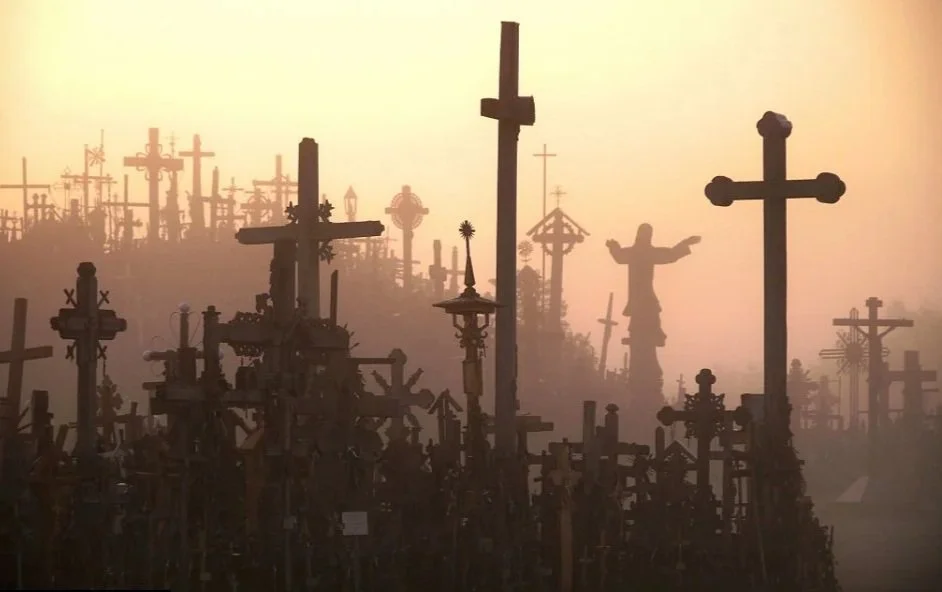
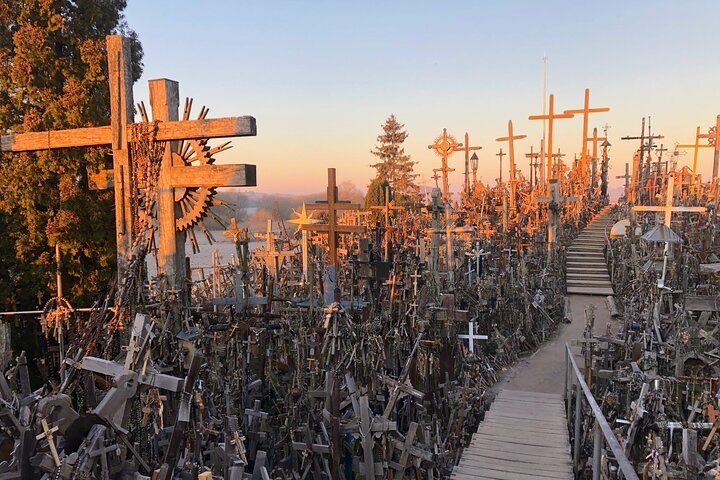
People travel from all over the world to the Hill of Crosses to leave their rosary beads or crucifixes.
Today, there are over 100,000 crucifixes standing on the mound, but the question remains, why do they come?
To answer that, first we must discover the origins of the hill, of which there are many theories.
One theory goes that a wooden church once stood on the hill, and one day during mass there was a terrible storm. Lightning struck and the building immediately erupted in flames, burying everyone inside under the fallen rafters. That’s why since ancient times, people have reported seeing ghosts wandering the hill, who many believe to be the souls of the patrons who perished in the flames.
Another story tells of a father who was desperately trying to save his ill daughters life. After a vision told him to make a wooden cross and place it atop a nearby hill to ensure his daughter’s recovery, he quickly did so. After running home, he was indeed greeted by the sight of his healthy daughter, and a belief in his vision was cemented. This theory is one that has fuelled plenty of folks into leaving their own crosses, in hopes and prayers for their loved ones.
But that’s not all, another legend tells that a 14th century Samogitian fortress once stood atop the hill as defence against the Teutonic Knights. After their defeat, the fortress was burned and the Samogitians returned to pile their dead on the smouldering ruins. Just like the souls believed to be seen wandering the hill from the burnt church, the fallen pagan warriors are believed to still inhabit the mound today.
But no matter what story you believe, the recent global popularity of the hill comes down to the actions of the Soviet Union in the 20th century. During the Soviet occupation from 1944 until 1990, Christianity experienced state-wide suppression and persecution. The hill was one of many sites which was torn down and destroyed in an effort to remove Christianity from peoples daily lives.
But time and time again, folks would come in the dead of the night and re-place crosses on the mound in a quiet act of defiance.
And time and time again it would be cleared away.
But today the hill still stands, so for many, it represents quiet defiance, or ‘Kęsti’ (to endure).
But for many, the hill is simply a place of contemplation and prayer.